


Two words carry most of the marketing in this category, and they describe different jobs. Adaptogens are sold for the stress side of the day; nootropics are sold for the performance side. Neither is a regulated or clinical category, which means the words tell you what a brand wants you to feel, not what is in the bag.
The bag itself tells you more, if you know which six numbers to look for. This guide walks through a functional coffee label line by line — mushroom form, doses, blend disclosure, sugar, cost per serving and lab testing — and uses HabitONE (https://habitone.co/) as a worked example at the end, limitations included. By the last section you should be able to sort a serious product from a decorated one in about a minute.
Two Words, Two Different Jobs
Adaptogen is a term from Soviet-era pharmacology for plants said to raise resistance to stress: Rhodiola rosea, ashwagandha, reishi. Nootropic is a newer label for compounds aimed at attention and memory: alpha-GPC, L-tyrosine, caffeine, L-theanine. Mushrooms drift between the two columns depending on the claim being made that week.
Most blends now carry both types, which is a reasonable formulation choice and a convenient marketing one. The problem is that a single scoop cannot deliver a research dose of six things at once, so the split matters: a formula that spreads 2,000 mg across six ingredients has made a decision about what it is not doing.
Practical consequence: read the panel as a budget rather than a list. Every milligram spent on a decorative ingredient is a milligram not spent on the one you actually came for.
Inside the Two Columns
The table below pairs the common ingredients with the amounts used in human trials and the amounts a cup usually carries. The gap in the last column is the single most useful thing to understand about this whole category.
| Ingredient | Column | Sold for | Dose in human trials | Typical per cup |
| Lion’s mane | Both | Focus, memory | 1.8–3 g/day of powder | 375–500 mg |
| Cordyceps (CS-4) | Adaptogen | Stamina, oxygen use | 1–3 g/day, 6–12 weeks | 500 mg |
| Reishi | Adaptogen | Calm, recovery | 500–1,800 mg/day | often undisclosed |
| Rhodiola rosea | Adaptogen | Fatigue, burnout | 288–680 mg/day | 100–150 mg |
| Alpha-GPC | Nootropic | Memory, output | 300–1,200 mg/day | 150–200 mg |
| L-tyrosine | Nootropic | Focus under stress | 100–150 mg per kg body weight | 500 mg |
Set the last two columns against each other and the conclusion is hard to avoid: a functional cup is a small daily contribution, not a clinical dose. That is not a scandal, but it does mean any label promising trial-grade results at these amounts is overselling.
Fruiting Body vs Mycelium: the Biggest Tell
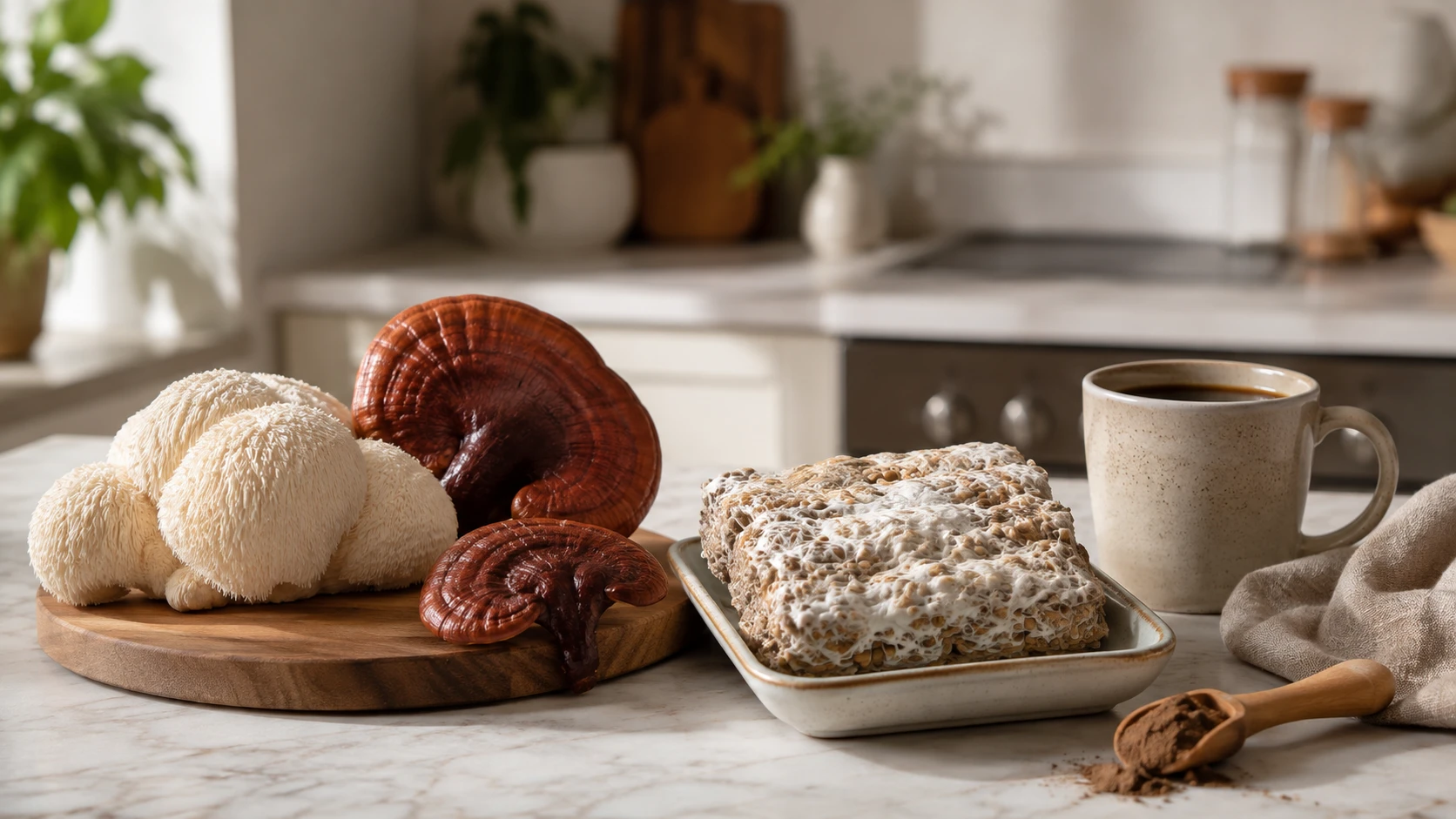
Mushrooms are the fruiting body — the part that grows above ground and the part nearly all research used. Mycelium is the root-like network, and in commercial production it is grown on sterilised grain, then dried and milled with that grain still attached. The label word for this is “mycelial biomass” or simply “mycelium”.
The analytical difference is not subtle. Using the beta-glucan method that McCleary and Draga validated in the Journal of AOAC International (2016), dried fruiting bodies run around 30-40% beta-glucans with under 5% starch, while mycelium-on-grain products commonly test at 5-7% beta-glucans and 35-40% starch — in some samples the profile tracks the grain substrate itself. Triterpenoids, the second family of compounds behind reishi’s reputation, are largely absent from grain-grown mycelium.
This is also why a “polysaccharides” figure deserves no weight. Starch is a polysaccharide, so a product with 5% beta-glucans and 60% grain starch can legally advertise “65% polysaccharides”. The number worth asking for is beta-glucan percentage, tested by a mushroom-specific method.
Effective Doses: Where Almost Every Cup Falls Short
The trial numbers are unforgiving. Lion’s mane produced cognitive changes at three grams of powder a day over 16 weeks, and at 1.8 g in a 28-day pilot. Cordyceps CS-4 trials that reported threshold improvements used about 1 g to 3 g daily for six to twelve weeks — and a 3 g study in trained cyclists found nothing at all.
Nootropics show the same pattern. Alpha-GPC trials for cognition ran at 1,200 mg daily, with power-output work at 300–600 mg, so a 150 mg inclusion sits below the studied range. L-tyrosine studies used 100–150 mg per kilogram of body weight, which is seven to eleven grams for a 70 kg adult; 500 mg on a coffee label is a gesture toward the research rather than a replication of it.
None of this makes the ingredients useless, and extracts concentrate actives so milligram comparisons across powder and extract are not one-to-one. It does mean the correct expectation for a daily cup is modest and cumulative — and that a brand printing real numbers, as HabitONE does across most of its panel, is doing you a favour, because it lets you run this comparison yourself.
The Proprietary Blend Loophole
Under 21 CFR 101.36, a brand may group ingredients under a proprietary blend name, declare the total weight of the blend, and list the components in descending order by weight — without disclosing a single individual amount. Everything about that is legal.
What it means in practice: a “2,000 mg six-mushroom complex” tells you which ingredient is largest and nothing more. The remaining five could total 100 mg between them, and the label would be fully compliant. A blend that hides its split leaves nothing to compare with a published dose, which is reason enough to treat undisclosed doses as a zero rather than a mystery. Panels without that wrapper — HabitONE prints each mushroom on its own line — can at least be argued with.
Sugar and What Hides in Latte-Style Blends
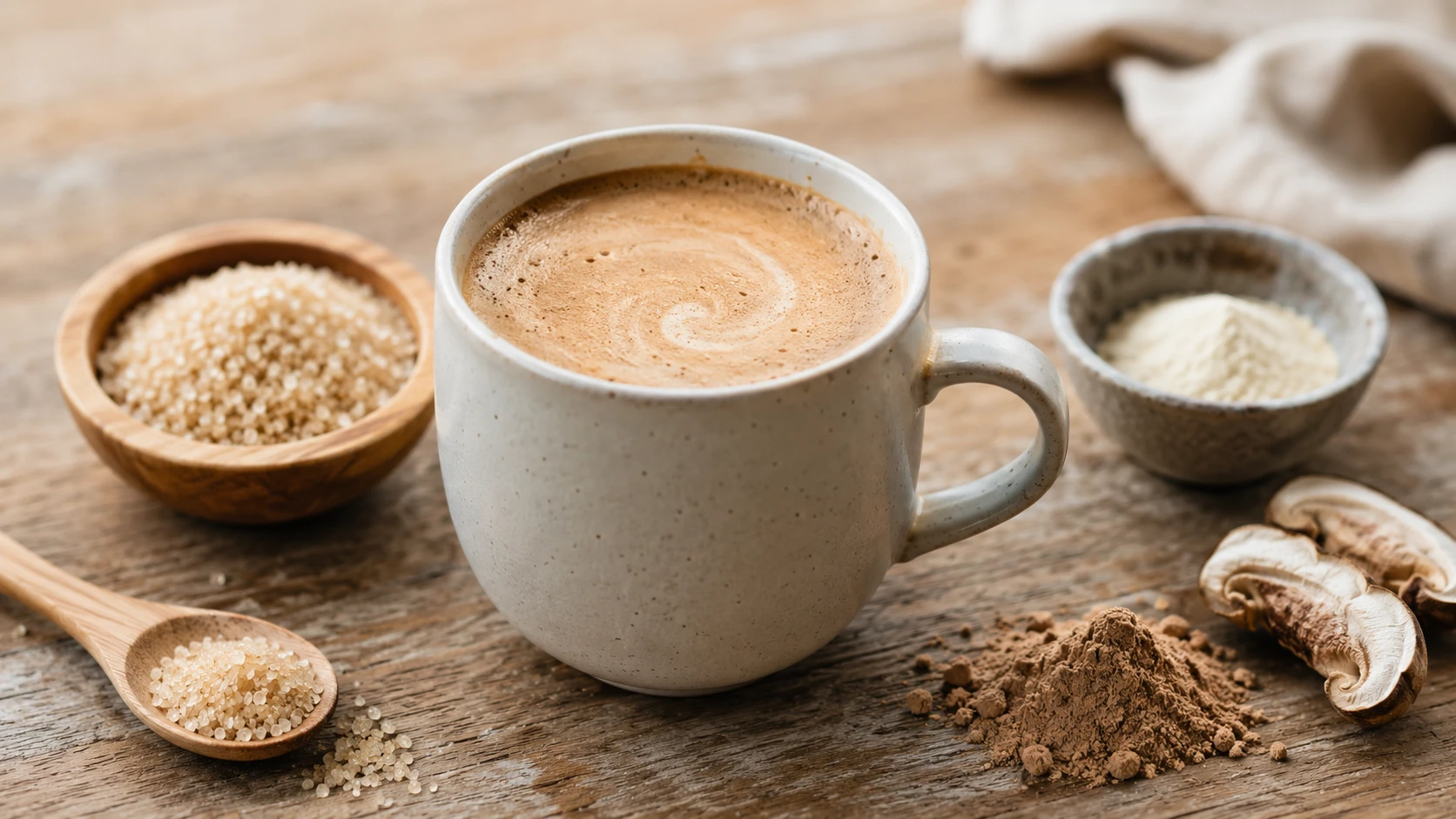
Plain instant blends usually carry no sugar at all. Latte-style products are where it appears, because sweetness covers the earthy note that mushroom extracts bring, and cane sugar is the cheapest way to do it. Read the Added Sugars line rather than the marketing copy — “no artificial sweeteners” is not the same statement as “no sugar”.
Calories work as a proxy in the same way. A blend at five to twenty calories per serving is essentially coffee plus extracts; anything north of forty has creamer, sugar or milk powder doing the work, which matters if you drink it while fasting.
Third-Party Testing: Metals, Mycotoxins, Pesticides
Fungi are efficient accumulators, taking up cadmium, lead and arsenic from whatever they grow on, which is exactly why the growing medium and its testing are not a detail. Coffee brings its own risk in ochratoxin A, a storage mould toxin, and both crops can carry pesticide residues.
The phrase to look for is third-party testing in an accredited laboratory, ideally ISO/IEC 17025, covering heavy metals, mycotoxins and pesticides. The stronger signal is a brand that will send a certificate of analysis for the batch code on your bag, since “lab tested” printed on a pouch is a claim, not a document.
Cost per Serving: the Only Price That Matters
Bag prices are designed to be incomparable, because servings per bag vary from 15 to 45. Divide the price by the number of servings and the picture flattens out immediately: most of this category lands between $0.60 and $1.90 per cup, with ready-to-drink formats above that.
Two adjustments make the comparison fair. Use the subscription price only if you intend to subscribe, and check how a serving is defined — some brands count a half-scoop as one, , which halves the printed price and the dose at the same time.
The Six-Point Checklist
Run a label through these six questions in order. The first failure usually tells you enough to put the bag down.
- Does it say fruiting body, and does it avoid the words mycelium or mycelial biomass?
- Is every mushroom and nootropic listed with its own milligram figure?
- Is there a beta-glucan percentage, or at least an extract ratio, rather than a “polysaccharide” claim?
- Does the Added Sugars line read 0 g, and do the calories match a coffee rather than a dessert?
- Is third-party testing named for heavy metals, mycotoxins and pesticides, with a certificate available by batch?
- What is the cost per serving once you divide, and does the caffeine figure appear at all?
Points one, two and five separate serious products from decorated ones. Points three, four and six decide between the serious ones, which is a much more pleasant problem to have.
What a Label That Passes Looks Like
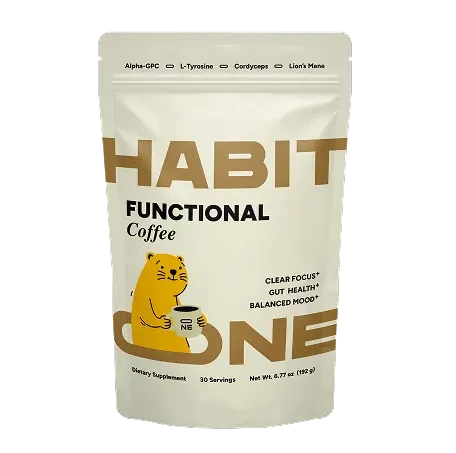
A functional coffee label with per-ingredient doses printed for each mushroom and nootropic
HabitONE is a usable worked example, because its panel survives most of the checklist rather than all of it. Per serving it prints:
- form: fruiting body throughout, with no mycelial biomass anywhere on the panel;
- quantified actives: lion’s mane 500 mg, cordyceps 500 mg, L-tyrosine 500 mg, alpha-GPC 200 mg, Rhodiola 150 mg;
- left unquantified: the chaga and reishi extracts, whose form is stated but whose amounts are not;
- no proprietary blend wrapper, so every figure above can be checked against a study;
- stimulant and sugar: caffeine printed at 85 mg from 100% Arabica, added sugars at zero;
- quality and price: third-party testing named for metals, mycotoxins and pesticides, roughly $0.90–1.50 per cup.
Where it passes: fruiting body only, four of seven actives quantified, no proprietary blend wrapper, sugar at zero, caffeine disclosed, testing named. Where it does not: chaga and reishi amounts are missing, and the quantified doses sit below the trial ranges in the table above — half a gram of lion’s mane powder against 1.8-3 g, and 200 mg of alpha-GPC against a studied floor of 300 mg. That is the normal state of this category, and printing per-ingredient figures is what makes the shortfall visible at all.
Is Mushroom Coffee a Scam?
Not as a category — but the honest answer has three parts. The mushrooms are real and the traditional use is old; the human evidence at cup-level doses is thin and mostly about fatigue, focus scores and wellbeing rather than measured biology; and a meaningful share of products sell grain starch under a mushroom name while promising outcomes no trial has produced.
What you are buying at a fair price is a lower-caffeine coffee with a modest daily dose of well-identified extracts, plus a taste you may prefer. What you are not buying is a clinical intervention. Judge any brand, HabitONE included, on the six points above rather than on the promise across the front of the bag — and a label implying otherwise has already told you something useful about the company behind it.
These statements have not been evaluated by the Food and Drug Administration. These products are not intended to diagnose, treat, cure, or prevent any disease.
This is a sponsored article
