


The red streaks on the unicorn’s flank at the Met Cloisters are pomegranate juice, and the Metropolitan Museum of Art says so in its own entry for the tapestry. Manhattan lets you look at a great deal of food before it lets you eat any, so a day of food and art in New York might as well start there, at the top of the island, and work south toward lunch. Save room. The museum part of the day ends at a counter under 42nd Street.
Cloisters, Frick, Oyster Bar: Pick the Right Day
The Met Cloisters closes on Wednesdays. The Frick Collection closes on Tuesdays, and the Grand Central Oyster Bar serves Monday through Friday only, from 11:30 a.m. to a last seating at 9:30 p.m. That leaves Monday, Thursday and Friday.
Adult tickets are $30 at each museum. New York State residents pay what they wish at the Met, and a Met ticket also gets you into The Met Fifth Avenue the same day. The Cloisters opens at 10 a.m. and the Frick at 10:30, so the order of the day more or less sets itself.
A Unicorn at the Met Cloisters
The tapestry hangs in Gallery 17. The Unicorn Rests in a Garden was woven in the Southern Netherlands between 1495 and 1505 and came to the museum from John D. Rockefeller Jr. in 1937. A white unicorn lies inside a low round fence, chained to a tree hung with fruit, and the fence is low enough to jump.
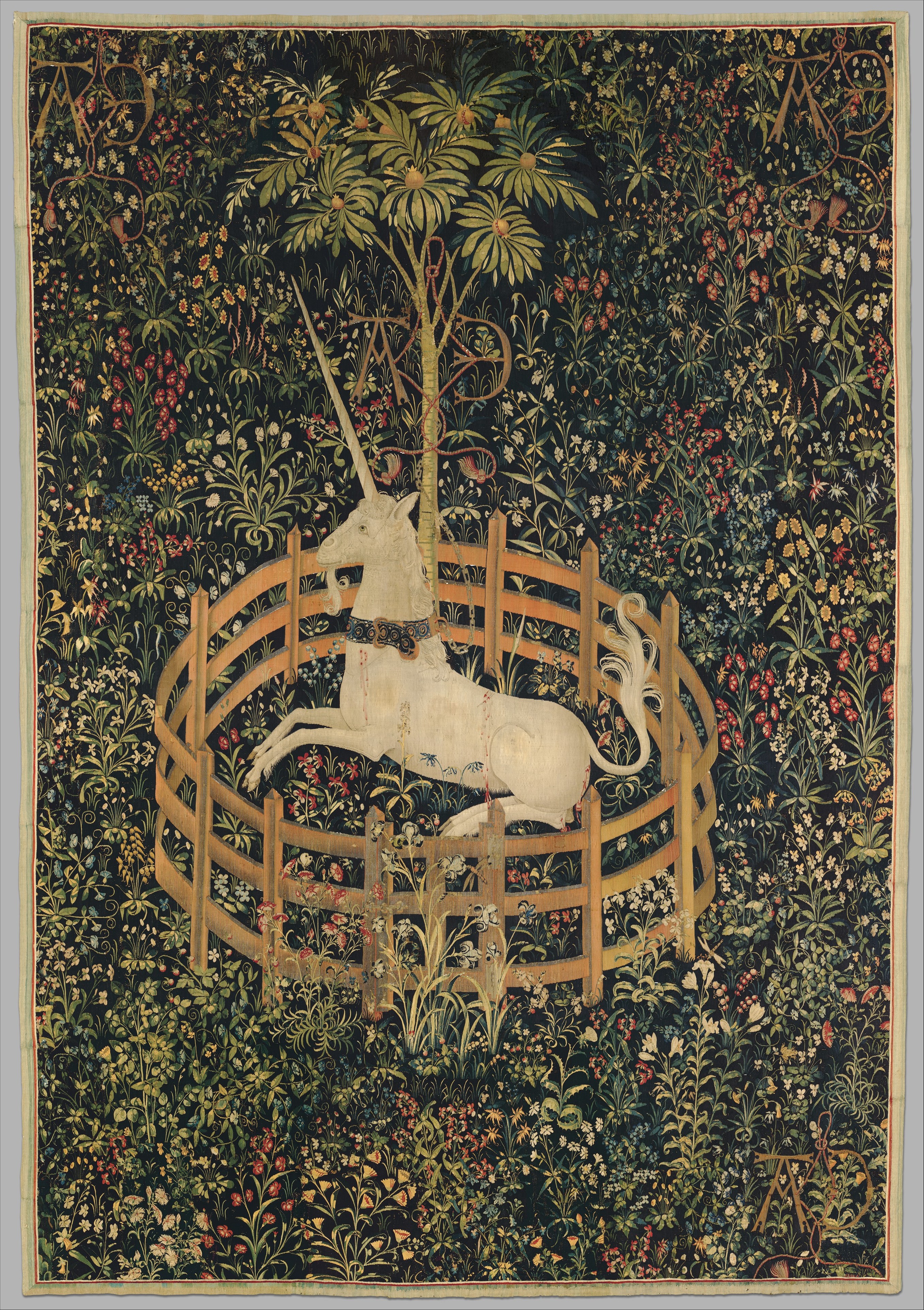
The Met’s reading is that he stays because he wants to. The tree is a pomegranate, “a medieval symbol of fertility and marriage,” the red marks are juice from the bursting fruit since he has no visible wounds, and even the small frog among the violets at lower right belongs to the theme, a creature medieval writers knew for its noisy mating. The unicorn under that pomegranate has a stop of its own on Chiaro’s independent audio guide to the Met Cloisters, and the talk opens on those red streaks.
What Grows in the Bonnefont Garden
Then walk out to the Bonnefont Cloister Herb Garden. The raised beds are grouped by what each plant was for in the Middle Ages, cooking among them, and the plant list starts from a ninth-century edict in which Charlemagne named 89 species to be grown on his estates.

Four quince trees stand at the center, two old and two young. The vegetable bed includes Good King Henry, rampion, white carrot, sea kale, lovage and Neapolitan parsley, and for anyone who cooks it is the best thing in the building. The pomegranate grows in a pot that can come indoors for the winter, and next door in the Trie Cloister many of the tapestries’ flowers grow and bloom in their own seasons.
Wild strawberries grow in both gardens. Carly Still, the Cloisters’ managing horticulturist, told the Met’s store magazine in 2021 that they are “absolutely tiny (think dime-sized berry)” and “full of flavor and sweetness,” and that in the Middle Ages, “as with the pomegranate, all the little seeds were associated with fertility.”
The Trie Cafe sits under the arcades of that cloister, in season Thursday through Tuesday from 11 a.m. to 4 p.m., with sandwiches, salads, wine and beer.
The Frick’s Untouched Glass of Red
The southbound M4 bus runs from the Cloisters to Fifth Avenue and 69th Street, a block from the Frick’s door at 1 East 70th Street. Henry Clay Frick bought Johannes Vermeer’s Girl Interrupted at Her Music in 1901, and it hangs in Room 19, the South Hall. A young woman looks straight out of the picture while a man leans over her shoulder, the two of them holding a sheet of paper that might be music or might be a letter.

On the table there is a stringed instrument that appears to be a cittern, a blue and white jug with a silver lid, and a small glass of red wine that nobody has touched. The Frick notes that scholars split over whether the jug is Chinese porcelain or Delftware made in Vermeer’s own town to imitate it.
Photography is allowed only in the Garden Court, and the paintings carry small plaques with the artist and title in place of wall labels. The wine glass and the argument over the jug both turn up in the talk on this painting in Chiaro’s audio tour app for the Frick Collection, which plays from the page without a photo.
The Oyster Bar, Where Food and Art in New York Share a Counter
Here, at last, the food is real. Grand Central Terminal opened just after midnight on February 2, 1913, and the Oyster Bar opened three weeks later with 440 seats, under vaults of thin terracotta tile laid in the system Rafael Guastavino, a builder from Valencia, patented in 1885.
The vaulted landing outside the doors is the Whispering Gallery. Stand facing into one corner, put a friend in the corner opposite, and talk at an ordinary volume into the tile. Each tile in the herringbone overhead is less than an inch thick, and vaults like these could go up without the usual centering underneath, as the closing talk of Chiaro’s self-guided audio tour of Grand Central Terminal explains on this very landing.
Inside, skip the dining room and its checked tablecloths and take a stool at the counter. The oyster stew is cream, butter and clam juice with the oysters cooked in it, $17.25; the pan roast adds sweet chili sauce and toast, $17.75. Add a Bluepoint or two at $4.55 apiece. Both bowls come out of swivel pots behind the counter that the restaurant says are heated by New York City steam, in about two and a half minutes.
Ruth Reichl wrote in this magazine in 2016 that she could not understand “how anyone would sit anywhere but at the old counter, in front of the stew cooks,” and that the smell of the stew, “that mixture of cream, Worcestershire sauce and oyster liquor,” makes her imagine her father on the next stool. “On the way out,” she added, “I always stop at the whispering gallery, to tell my secrets to the wall.”
Where FOOD Used to Be
If you still have legs after lunch, keep going south to Prince and Wooster in SoHo. In October 1971 the artists Carol Goodden, Tina Girouard and Gordon Matta-Clark opened a restaurant called FOOD at 127 Prince Street, on that corner, and staffed it with artists who needed the work. On Sunday guest-chef nights Robert Rauschenberg served a chili of his own invention, and Matta-Clark staged a dinner he called Matta Bones. The founders had stepped back by the mid-1970s. To see the room, find Matta-Clark’s 1972 film Food, 43 minutes in black and white, with Robert Frank among the people behind the camera; Electronic Arts Intermix distributes it.
