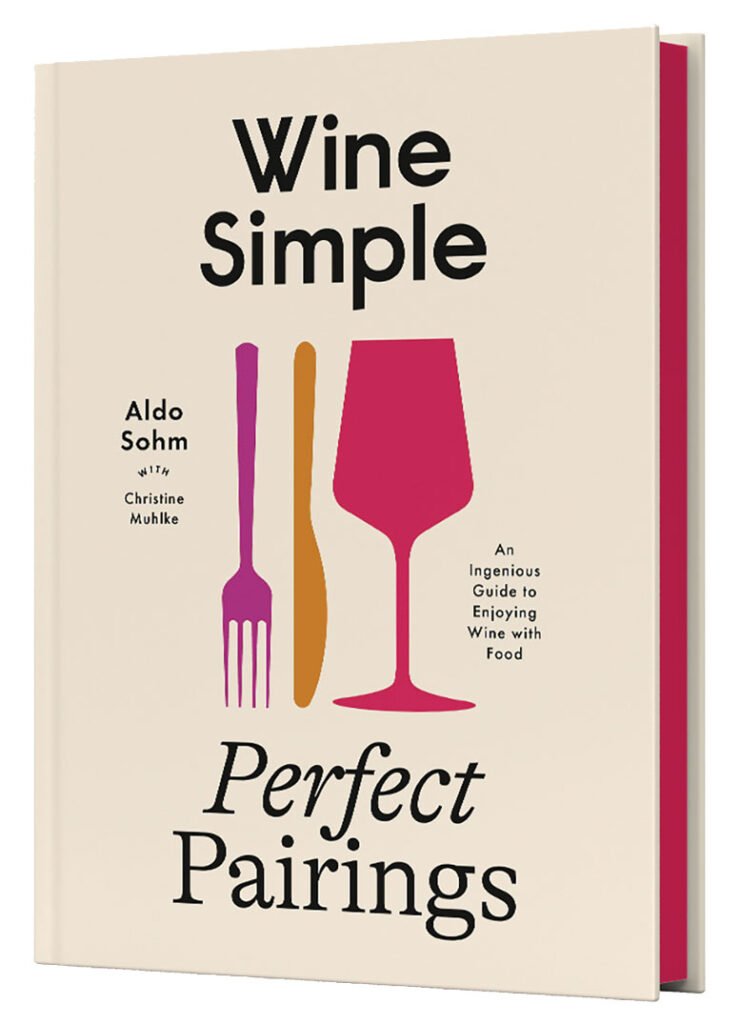

In his new book with writer Christine Muhlke, Le Bernardin sommelier Aldo Sohm brings wine and food together, and to the people.
Recently, at Ensō Omakase in Williamsburg, I tried fatty tuna with a light white from Sparkling Pointe Vineyards on the North Fork, and the result was stupendous. As soon as I got home, I cracked open Aldo Sohm and Christine Muhlke’s Wine Simple: Perfect Pairings to find out why. Thankfully, this sequel to their smash hit Wine Simple (which, with the help of art director Alaina Sullivan, helps decode every wine at every level) is as helpful, intelligent, and elucidating as its predecessor. The book asks readers to interrogate elements of food and wine—like weight, intensity, flavor, acidity, sweetness—not just follow rules. I had a chance to sit down with the authors, who revealed which white goes with Szechuan, the things pairings share with marriage, and how we’re sleeping on sherry.
Was the success of Wine Simple surprising?
Muhlke: Wine books don’t traditionally sell like that. Even before the pandemic, it was being published in Ukraine, in Korea, there’s a German edition, Chinese. It really resonated.
What challenge did pairings add?
Muhlke: Aldo had to create an entirely new way to explain how a certain wine goes with a certain dish. People talk about the 10,000 hours [required to achieve expertise in nearly any skill]; Aldo has the 10,000 glasses, and the 10,000 dishes. Times a million. When you know something in your bones like that, how do you put it into words? How do you make it a bite size? It’s not “White wine goes with fish and red wine goes with steak.” Aldo will always ask, “How did you cook it? Did you sauté it? What’s the sauce with it? Did you add butter?” And you’re just, like, “Answer the question Aldo!” But he can’t, because that’s how deep it goes.
Sohm: Wine pairings is something I do for many, many, many years. The difficulty is in translating that. We came up with Josephine [the name they gave to their imaginary perfect pairing subject].
Muhlke: Josephine is learning She’s getting away from the Pinot Grigio and starting to branch out. Maybe she’s read Wine Simple and she wants to take it a step further. So, I’d always ask, “What’s Josephine gonna order?”
Sohm: We made her sensitive to different elements. For instance: alcohol fetches and transports flavors. Fat has a similar component. It catches flavors and dissolves them. Take string beans and then add a little bit of butter: It’s a very different flavor; [the fat] gives it more weight. Now, what fat are we talking about? Is it fat from a steak or from a chicken? Or is it fat from olive oil or butter? Or is it simply grated parmesan cheese? Same thing with sweetness: Is it just regular sugar? Is it honey? Or could it be also that you roast your Brussels sprouts, and they pick up some sweetness; same of carrots. Those are the things you take into consideration.
We started characterizing all the wines, from light to crisp, from medium to expressive, from complex and full body; we created the wine weights: 1, 2, 3, 4, and so on. I’ll give you a good example: Muscadet is a wine weight 1. It’s very lean, very mineral, very focused. It’s very light, because it has 12% alcohol.
My ultimate pairing question: What wine do I drink with Chinese food?
Sohm: It’s a complicated question.
Is there an answer? Is the answer “beer”?
Sohm: China is a large country. If you go into the heat-based dishes, that changes literally everything. If you really pressed me into the corner, I would stick in the Riesling camp. You have a little residual sugar just to coat the heat. There are some tricky ingredients. Chili happens to be one of them.
Let’s talk about natural wine and pairings.
Muhlke: This is where Aldo and I disagree.
Sohm: Before we wrote Wine Simple, I was very against natural wine, and here’s why: It annoys me when people become tribal. Wine is something which brings people together. It shouldn’t bring us apart. And who are you to tell me “This is supposed to be delicious, and the other one is rubbish?” At the wine bar, you assemble 10 random people from all walks of life; they start talking with each other. Now, all of a sudden, someone tells them, “This is supposed to be rubbish, because it’s not natural. And this is natural: it’s delicious, right?”
After Wine Simple was released, I became very good friends with Christine and started asking questions. And we debated all night, many nights. I went to see natural winemakers. Then I started asking about each other, and that’s when I saw, “OK, this is becoming interesting.” I realized natural wine is mood driven. I have to be in the mood to drink champagne. I’m not a moody person, but I’m a very moody drinker, OK?
Listen, if you’re in the mood for oysters, you’re in the mood for oysters. If you’re not in the mood for oysters, they can bring you the greatest oysters on the planet, and it’s not delicious.
Any big pairing surprises?
Muhlke: I was surprised to bring sherry into the meal. Sherry is super unloved. I love Indian food, and I was really surprised to see that tandoori chicken would pair with an Etna Rosso. I went to Le Bernardin and Aldo walked me through the [pairing] process. And it involved 10 glasses for one dish. “Why would you put a Riesling with fish? Let’s see what happens if we do a red wine with fish, just to explore.” It’s like a stereo. That was the biggest surprise: to really see how he works.
Sohm: Yesterday, some friends brought in their daughter, who is a big foodie. She wanted to have a white wine, which was lean, very light, not too sweet. But then they ordered the Dover sole with the toasted almonds and brown butter soy emulsion and I brought her a Vino de Pastos. I said to her, “Look, the wine on its own, you will absolutely despise, I guarantee you this.” She looked confused as to why I would bring it to her. I said, “This is a little bit like the perfect marriage. Two people come together and both elevate without one topping the other. The wine on its own—we behave slightly differently when we are single than when we are married. You will see that wine literally melts together and makes this dish explode. She finished and said, “You’re so right. At first, I didn’t like the wine at all, but in combination it’s so good.”
Muhlke: Aldo even writes about why white wine is better with leftovers, because he thinks about the texture and flavor and what happens with food as it sits. It’s very granular, but interesting.
This is the opposite of granular, but is there a wine you keep on hand for easy pairing?
Muhlke: I always have champagne. After this book, I’ll always have a Spanish white usually, a Palomino Fino. Sohm: Historically, wine has always been paired with food. Roman soldiers, this was part of their salary. I think we’ve lost something: It doesn’t have to be expensive. Often the simplest wines are the ones which give you the most joy, because no one puts the expectation up to the ceiling, where barely a sheet of paper between your head and the ceiling fits through. Now, to answer your question, I always have a Grüner Veltliner. I’m fully biased, of course.