

Twenty years ago, my brother—who led bike trips in Alaska—toured a salmon farm. He has not eaten the fish since. You don’t need to google “salmon farm” to find out why. In fact, I recommend you don’t. Instead, just know that there’s something called “salmon lice” and these farmed fish are rife with it.
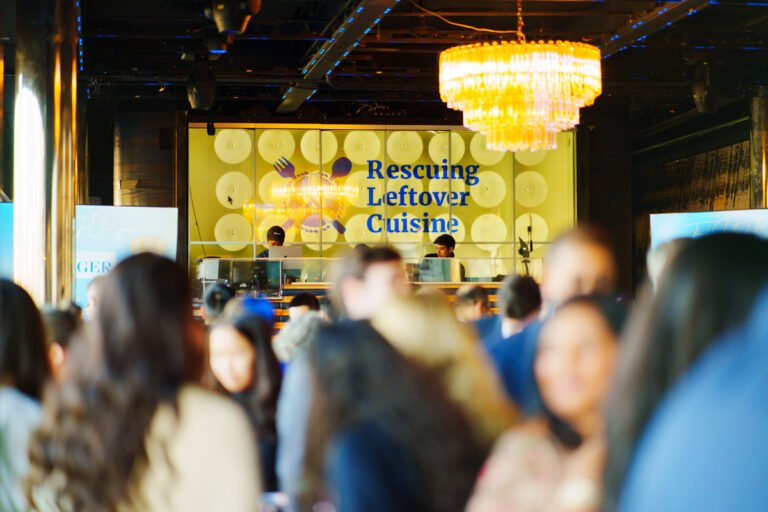
This rather unappetizing fact may not be the most advisable fashion in which to begin an article about a dinner, but last night’s do at Pioneer Works was enacted to address this out-of-control, pink problem. The event, which took place at two long tables in the main hall of the 27,000-square-foot former iron works and Red Hook art institution, was hosted by Off The Table, an organization dedicated to convincing chefs to use wild salmon, while we still can.

This is an oversimplification, but of the 2.5 to 3 million metric tons of salmon sold every year in the US, 70 to 75% of it is farmed. That sea cage farming is a leading driver in the extinction of wild Atlantic salmon. Beyond the lice and other diseases they bring with them, fish that escape from open net-pen marine farms often interbreed with wild fish, which creates generations of mutant ug-fish, drastically lowering their fitness and survival rates.
“Imagine having a Purdue chicken breed with a wild chicken in Thailand,” says Kateryna Rakowsky, a board member of the North Atlantic Salmon Fund who helped put the evening together. Over monkfish skewers and coal smoked beets with mussels, Rakowsky patiently but fervently laid out the issue for approximately 80 philanthropists, chefs, artists, and scientists—including Derrick Adams, Marquise Stillwell, LaJuné McMillian, and Talia Mota—as well as art and fish fans.
The food was prepared by chef Pierce Abernathy—a participant in Off the Table—who also screened a preview of his short film, which examines alternative seafood and farming solutions across New York. In some brief remarks after the screening, Pierce summed up his own goals in participating, saying: “I’m getting closer to the food I’m cooking.”

The dinner was thrown in conjunction with two oceanic-themed exhibits, including “Siphon,” a multimedia installation drawing on research of octopus consciousness (if you’ve ever wondered about octopus dreams, this is the art exhibit for you) by artist Tuomas A. Laitinen, who was in attendance.
Laitinen is Finnish by birth but lives in a remote area of Japan, about two hours from Tokyo. We talked for a while about eating local fish before the conversation turned to bears, of which the ecology-minded artist has made work in the past.
“We have a good name for the bears in Finland: the golden apple of the forest,” he says, explaining that in some indigenous cultures, you can’t name the bears aloud because the bears hear everything. “The bear was a mediator between the heavens and the earth. The earth is the ear of the bear,” he says.


Salmon, for tribes of the Pacific Northwest, tends to symbolize prosperity, determination, and renewal—which makes sense for a fish that famously swims, upstream, to spawn (resulting in many bears getting fed, as well). “A lot of people don’t know that salmon go back to the original place where they were born [to reproduce]” says Rakowsky. Interesting, of course, but for our purposes—and chefs’—that’s not the thing about salmon you need to know: if it’s on a menu, and it’s not accompanied by the word “wild*” don’t order it. And maybe mention why.
*Importantly, studies have shown that between 13% and 23% of salmon labeled “wild” on menus were in fact farmed. So, it’s a real “know-your-chef” situation. Also, be wary of obfuscating terms like “ocean-raised,” “organic” and “responsibly raised”…these all mean farmed.